
Energy and Potential
- Energy can never be created, or destroyed. 1st law
- Energy can move from place to place 2nd lawFor movement to occur there needs to be potential or a difference.
A battery has 2 terminals, 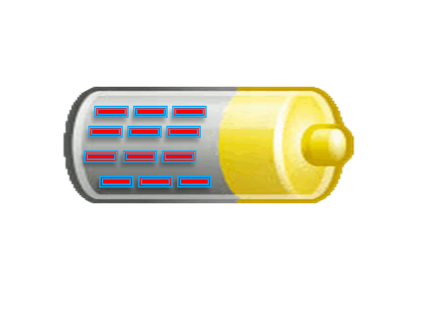
Under one terminal there is an excess of electrons and a shortage
of electrons under the other terminal.
Air moves from high pressure to low pressure.
Heat moves from high temperature to low temperature.
Moisture moves from wet to dry.
The rate of transfer, quantity and speed is always dependent on the potential
How Heat energy moves
- Radiation - Line of sight
Standing in the shade prevents the suns direct radiation.
We radiate our body heat to cold surfaces around us. - Convection – Transfer of heat by currents in the air or fluid.
Warm fluids are more buoyant and rises while cold fluids are dense and fall.
Older baseboard heating used this method. - Conduction – Heat across a wall or object propagating by touch.
Heat one end of a spoon and the heat travels by conduction to your fingers
The heat that travels through the building envelope or shell.
Insulation is designed to limit conductive losses. R value for resistance of this.
DeltaT or heat potential
Heat travels from hot to cold. The rate of transfer is proportional to the temperature difference. Delta T is abbreviated by ∆T.
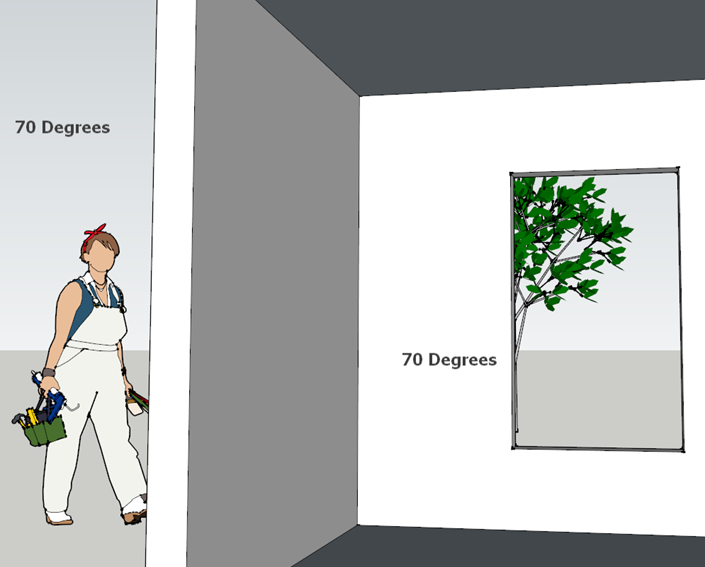 0 ∆T
This image shows a wall separating an outdoor temperature of 70 deg and an indoor temperature of 70 deg.
The ∆T is zero, and there is zero potential on both sides of the wall.
∆T of 65
This image 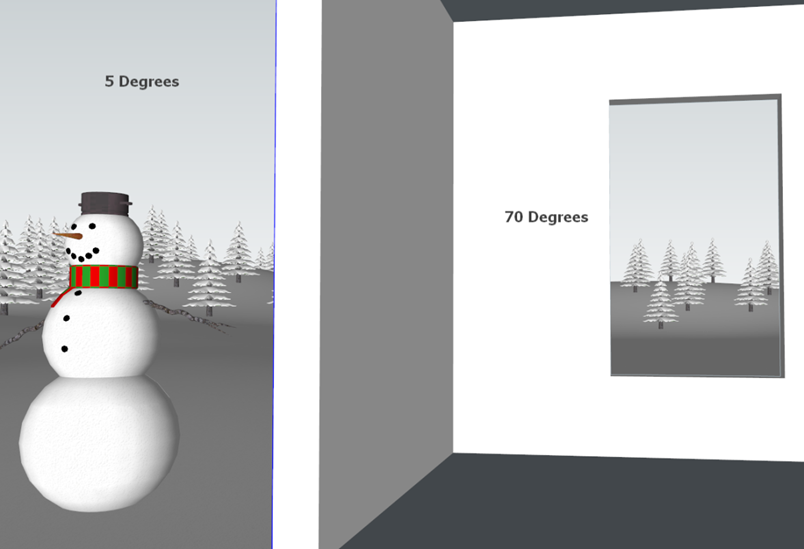 shows an outdoor temperature of 5 degrees with an indoor temperature of 70 degrees. The walls ∆T = 65 degrees. There is potential across that wall
If the temperature is the same on both sides there is no movement of energy.
A ceiling usually has a different “Difference” than a wall, or floor.
Temperature difference if often abbreviated by TD or ∆T
ΔT is fundamentally important.
If your the warmest object in the room, you are the rooms Sunshine
If you are the warmest object in a room, and during the winter you walk by a window,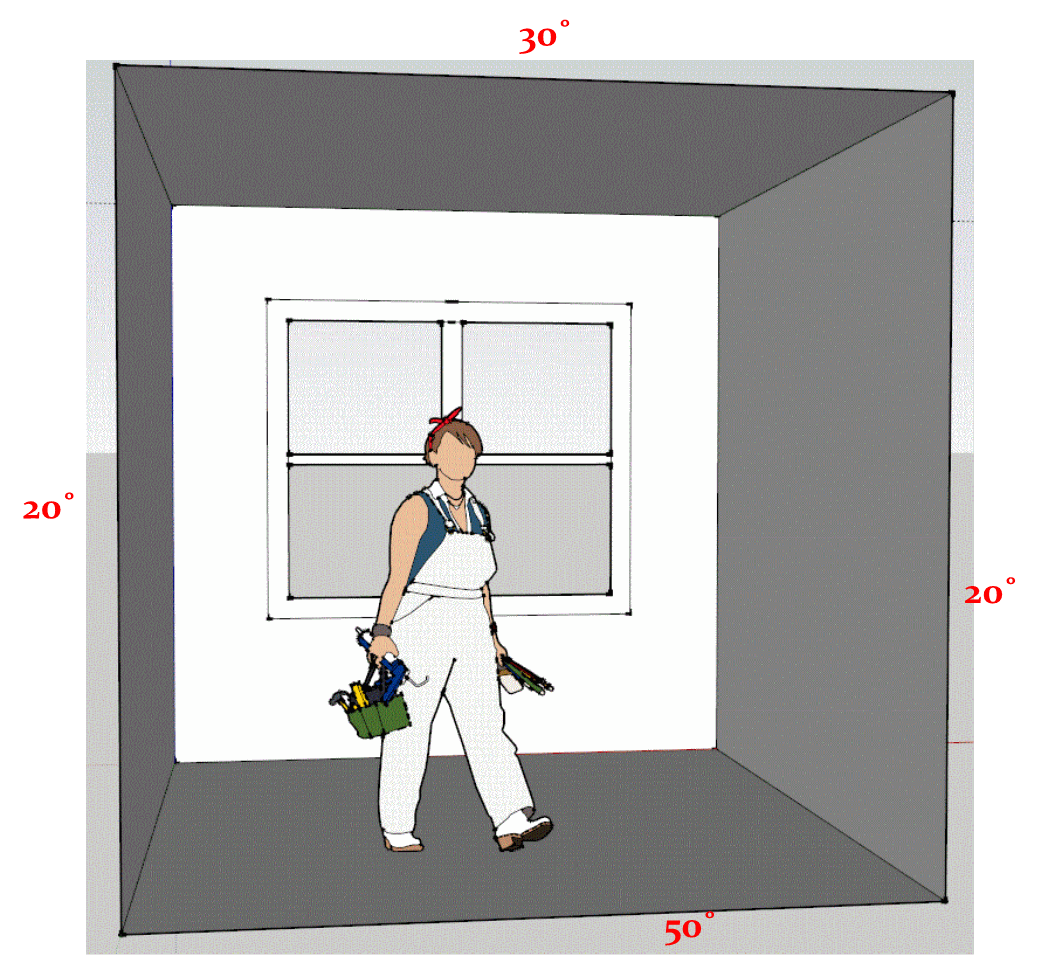
The cold you feel is NOT the cold coming to you. but your body's inability to keep up with your heat loss.
Regardless of air temperature, if all of the surfaces surrounding you are colder, your body will feel an average of that loss…
For “low tech” home improvement, I used to say “Insulation makes you feel warm, Air sealing saves you money”
Measuring Heat
British Thermal Unit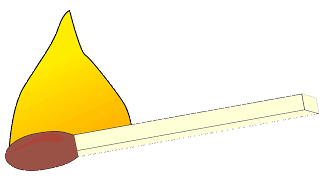
- 1 BTU is the amount of heat needed to raise the temperature
of 1 pound of water by 1˚ F - 1 BTU is close to what one wooden match stick generates.
Speaking about how hot something is, does not say how much heat it has.
(Bonus: Saying “Heat Flow” is technically poor English, heat is a verb. It already describes the movement of energy. Analogous to saying “Run Ran”.)
Battle of BTU’s
A BTU will effect the temperature of different materials in different ways.
- 1 aluminum coffee cup, filled with water and 1 aluminum a cup, SOLID aluminum.
- Light two torches, Hottest part of torch flame touching each for 60 seconds.
Which cup would you be willing to grab with your bare hands ???
- Water needs more heat, more than almost any other material on earth, to change its temperature.
What are we mostly made up of ?
What do our surroundings (Sheetrock, Counter top, floor etc.) more closely resemble ?