
Building Science, helps to understand the forces working against a home.
To fully understand Energy Efficiency, in construction, a knowledge of basic Building Science is required.
If you don’t fully understand the properties and methods, for the forces that work against the home, the big picture becomes much less clear.
Knowing what Building Science is, and what BS is,
can only happen after you understand both.
Air Density
The amount molecules in a given volume of air changes as its temperature changes.
As the temperature of the air falls, the molecules move more slowly and take up less space. As they take up less space, more can fit in that given volume.
Conversely, if the air is heated, the molecules move faster and further apart.
Warm air has less air in any given volume. It also weighs less than cold air.
We can get a perspective of this if we think about driving on a hot summer day, with the windows down. There are times when we can barley feel a breeze.
Think about how windy and noisy it is during the winter when you have 1 window down only a few inches.
Relative Humidity
- Relative Humidity is the amount of water vapor the air can hold.
- At one temperature, 1 cubic foot of air will be able to hold a certain quantity of moisture before it reaches saturation.
- 1 cubic foot of warm air can hold more moisture than 1 cubic foot of cold air. As we just learned, warm air is less dense than cold air.
- Since warm air is less dense, and there is more space available between the air molecules to hold water vapor.
Cold air is dense, with less space available for moisture.
If you take 1 cubic foot of cold (already relatively dry air) and heat it,
what happens to the size of that air ?
As the volume increases, what happens to its relative humidity ?
Psychometrics'
Psycho metrics‘ is the science of vapors in a gas. For our Atmosphere, a psychometric chart can be used to understand potential problems while designing a home.
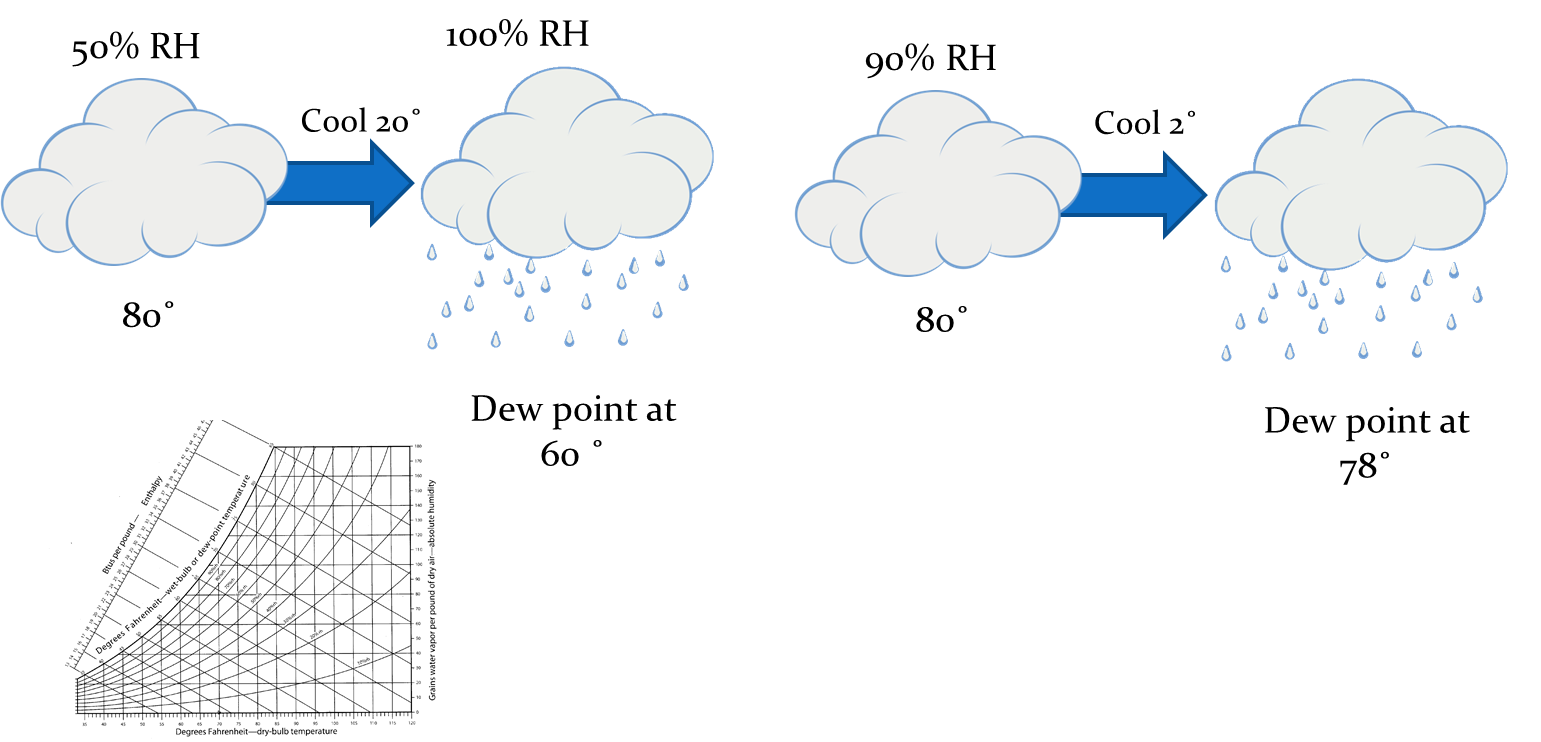
If you have 80 deg air at 50% RH, cooling it by 20 Deg would cause it to rain. Its dew point is met at 60 Deg.
But if you had 80 deg air, at 90% RH cooling it only 2 degrees would cause it to rain!
For the climate in my location, this happens many times through the summer, and is the cause of many home failures.
Condensation
On Long Island, we have more heating degree days than cooling degree days.
We need our heating 53% of the time and cooling 47%.
We need to not only worry about a vapor barrier for the winter, so our warm, 30-40% indoor RH wont condensate in our wall, we need to worry about the summer, where the opposite can happen, warm humid air, condensing on a cold indoor surface during the cooling season.
Very little moisture diffuses through building materials.
Our biggest culprit is air leakage paths.
Fact !
A 100 Sq Ft wall without a vapor barrier,
Would take an entire year for 2/3rds of a pint of water to diffuse through….
6.2 Gallons can enter through 1 single ½” round hole WITH a vapor barrier
What does this tell us about the importance of air sealing ?
Infiltration, Exfiltration & Ventilation
- Exfiltration uncontrolled is air loss out of a home.
- Infiltration is uncontrolled air movement into a home.
- Uncontrolled, the amount of air and time frame it occurs over, is not up to you.
- Ventilation is mechanically designed, controllable and adjustable for the amount of time.
Airflow in Buildings
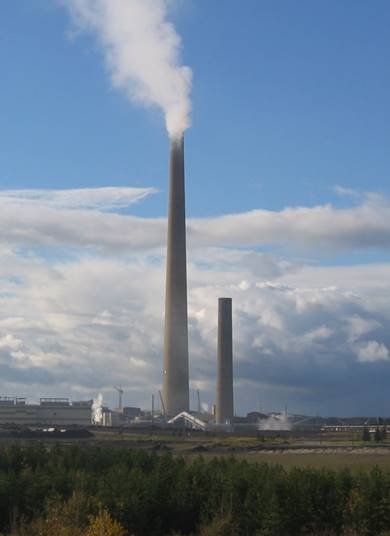
1) Warm air rises, exfiltrating through gaps and penetrations in the building shell.
2) For every cubic foot of air lost another cubic foot of air enters from infiltration.
3) Stack effect in a home acts like a chimney.
4) The height of the building and temperatures
determines the strength of these forces.