
Perfect conditions
How many days of the year is it "perfect" outside ?
5 days?
10 days?
20 days?
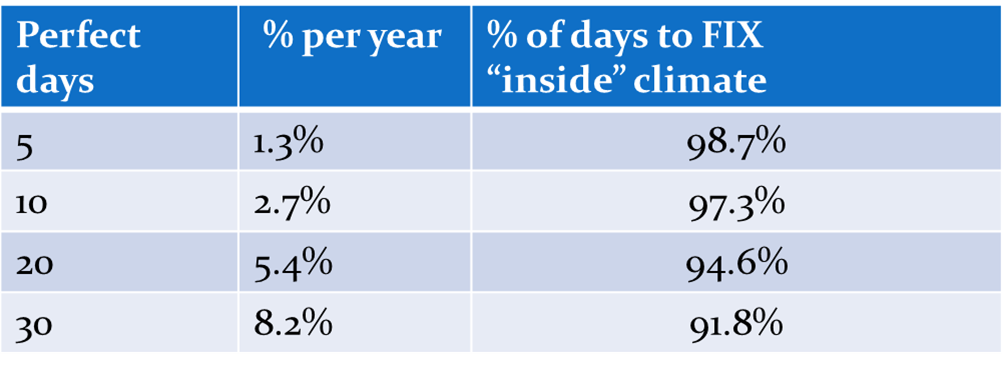
If you chose 20 days, you would need your HVAC equipment
94.6% of the time, to create your perfect indoor weather.
System Design, begins with Design Conditions
Naturally, location determines what we need to plan for.
For heating, the winter temperatures are recorded over 30 years. The winter design temperature chosen is 1% warmer than the coldest 1% or 99% of the coldest that station sees.
For cooling, exactly the opposite happens over the same 30 year time frame.
The temperature that represents 99% of the warmest is chosen.
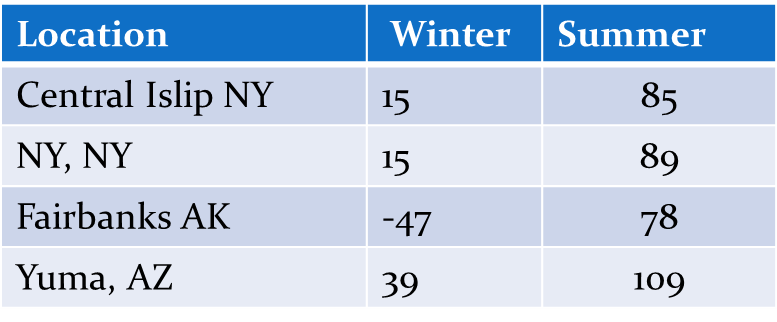
These are the design temperatures for the locations shown...
To download the a complete listing
So why not design for the worst ?
Heating.
- We can never purchase a system that matches our exact needs.
If you need 140,000 BTU’s, chances are you wouldn’t buy a system that maxed out at 120,000 BTU’s but would purchase one that delivered 160,000 BTU’s. - Generally Manual J methods have a built in “fudge factor” to begin with.
Some say it can be as high as 15%. - Internal Gains can close the gap.
- Comfort range varies according to seasons.
- Steady State Efficiency. A boiler that never reaches steady state, or infrequently runs at steady state runs at lower efficiency.
Cooling.
- All of the above.
- Proper dehumidification during the entire cooling season can be greatly
diminished by sizing the equipment for worst case scenarios. An oversized system would not run long enough during design conditions to remove humidity. Ideally the system would hardly shut off at design temperatures. When a system is installed correctly, it will also run longer during times when cooling needs are not as high, ensuring proper dehumidification.